About the Journal

Journal of Asian Social Science Research (JASSR) is a peer-reviewed, open-access journal for high-quality research and review articles on Asia and in relation to Asia. It welcomes contributions from scholars based in Asia and beyond and seeks to foster internationally recognized conversations in the social sciences grounded in Asian contexts.

JASSR’s focus and emphasis include contemporary changes and developments across Asian communities, with a special interest in Indonesia and in non-Western/Global South perspectives and epistemologies. Comparative studies of Western and Eastern/Global South/local intellectual tradition or across two or more countries are encouraged, as are inter- and multidisciplinary approaches. The scope spans—though is not limited to—sociology, anthropology, political science, public policy and public administration, education, communication and media studies, religious studies and the sociology of religion, history, and cultural studies, using qualitative, quantitative, or mixed methods.

JASSR aims to develop Asian social science scholarship; provide a forum for researchers, academics, and policy-makers to address pressing regional issues; bridge Indonesian, Asian, and international scholarship; uphold ethical, transparent, and inclusive publishing practices aligned with international standards; and promote open science and policy-relevant findings that inform public debate and governance.

JASSR is published twice a year by the Centre for Asian Social Science Research, Faculty of Social and Political Sciences, Universitas Islam Negeri (UIN) Sunan Gunung Djati Bandung, Indonesia, since 2019. JASSR accepts manuscripts in English and charges no submission or publication fees, providing immediate open access to all articles.
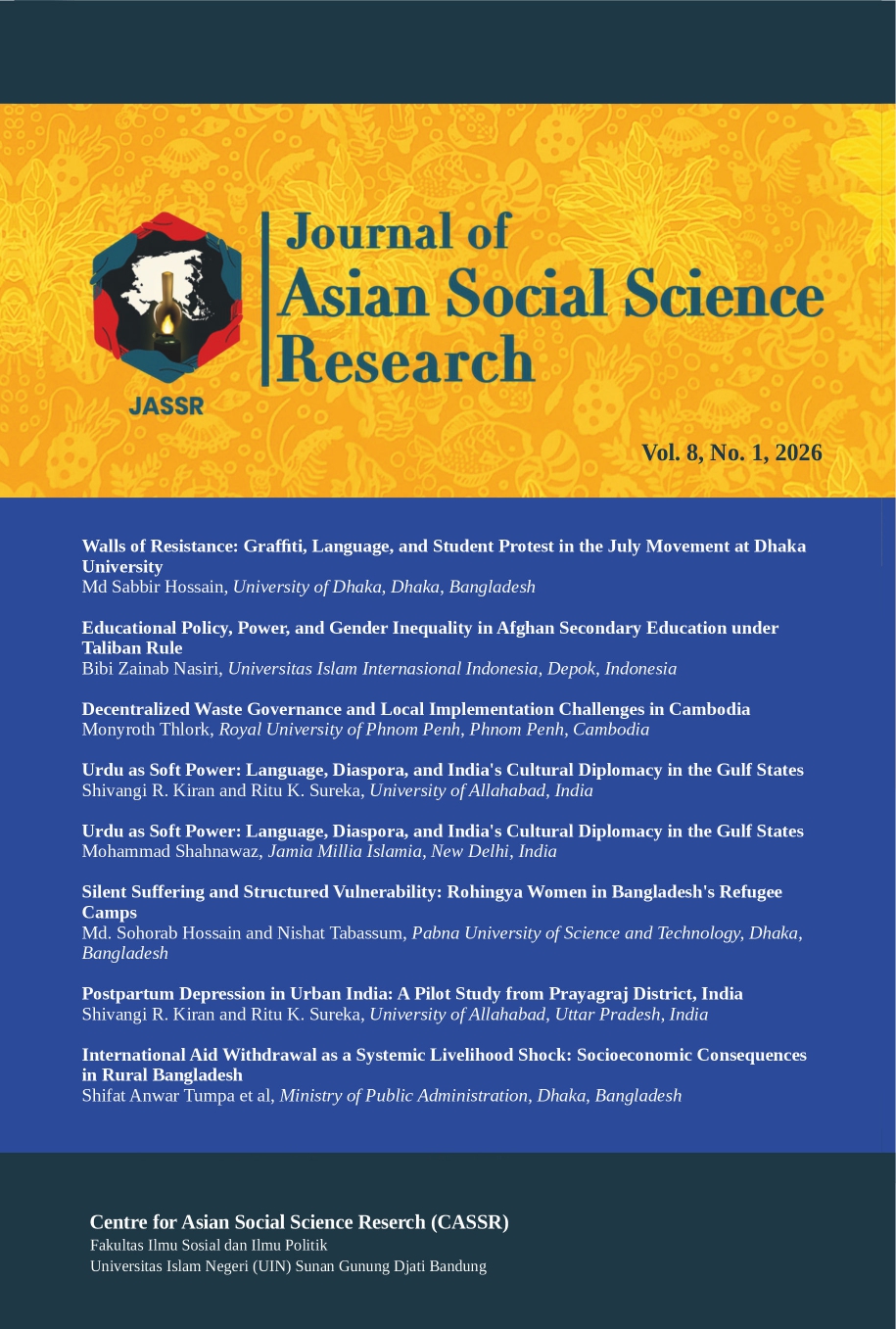
Current Issue

Vol. 7 No. 2 (2025): Journal of Asian Social Science Research
					View Vol. 7 No. 2 (2025): Journal of Asian Social Science Research

Editors’ Introduction

Welcome to Journal of Asian Social Science Research, Vol. 7, No. 2 (2025)

As 2025 draws to a close, it is hard to ignore how the year has felt simultaneously crowded and condensed: crises arriving faster than institutions can absorb them, public debate shaped in minutes and judged for months, and old questions about authority, belonging, dignity, and security returning in new guises. In many parts of Asia, the pressures have not only been political or economic, but interpretive. Who gets believed? Which stories become “common sense”? What counts as tradition, evidence, reform, or apology, and who has the standing to say so?

This issue is assembled in that end-of-year atmosphere, when reflection becomes unavoidable and simplifications feel especially tempting. The articles gathered here resist those shortcuts. They show meaning being made, contested, and operationalised across different arenas: in the mosque and on the feed, at the tomb and in the campaign, inside the household and across regional policy forums, at the distribution line and within local patronage systems, and in diplomatic theatre where a single apology (or its absence) can ripple into livelihoods. What emerges is not a single verdict on “where Asia is headed,” but a set of careful, grounded accounts of how power travels through platforms, institutions, families, and symbols.

We open with Imtiaz Hussain’s study, “Pakistani Mosque Imams’ Perspectives on Youth Religious Extremism on Facebook and YouTube: A Diagnostic Survey.” At a time when discussions of online radicalization often swing between moral panic and technological determinism, Hussain’s decision to foreground mosque imams as key informants is both pragmatic and analytically revealing. Using a survey of 411 imams in Punjab, guided by Uses and Gratifications Theory, the article maps how religious leaders perceive Facebook and YouTube as channels through which extremist ideas circulate among youth—and, importantly, how these perceptions vary by residence, education, and experience. The piece offers empirical detail where public debate can be thin, and it invites a difficult but necessary conversation: what does effective prevention look like when community leaders themselves are not simply “targets” of policy, but potential co-authors of counter-narratives and digital literacy efforts?

From Pakistan’s platform-mediated anxieties, we move to Indonesia’s layered religious landscape through Yanwar Pribadi’s “Religious and Political Narratives in Islamic Iconization: The Case of Kyai Kholil of Madura.” The article treats iconization not as a static label bestowed by tradition, but as a living process, maintained through pilgrimage practices, pesantren networks, and contested memories. Pribadi’s anthropological fieldwork and careful engagement with historical and biographical materials illuminate how Kyai Kholil’s saintly reputation, genealogies of learning, and symbolic proximity are mobilized across devotional and political arenas, particularly within Nahdlatul Ulama milieus. Read alongside broader debates about charisma and authority, the article offers a grounded reminder: in many communities, the past is not “behind” politics. It is one of politics’ most renewable resources.

Several contributions in this issue refuse to separate “public policy” from “private life,” showing instead how they are braided together. Md Abdul Jalil’s Marriage Dissolution through Divorced Women’s Voices: New Insights from Bangladesh” centers divorced women’s narratives: what dissolution meant to them, what pushed them toward it, and how they interpret the decision after the fact. The findings depict divorce as neither simply tragedy nor straightforward liberation: women describe education and employment as enabling autonomy, while also pointing to polygamy, extramarital affairs, in-law interference, tensions around social media use, and family influences as drivers of breakdown. Particularly striking is the coexistence of relief and regret—agency and self-blame—in the same accounts. The article’s contribution lies not only in documenting reasons, but in showing how moral evaluation is lived: how women carry the social and emotional calculus of divorce long after the legal event concludes.

Gender, in this volume, is also examined at the scale of regional diplomacy and institutional strategy. Ilham Dary Athallah, Hayara Khairia, and Tsabita Husna, in “Indonesia’s Strategic Rationale for Championing the ASEAN Gender Mainstreaming Strategic Framework,” take up an apparent paradox: why push hard for a regional gender framework if domestic regulations already exist? Their answer, built through qualitative analysis of policy documents, statements, and scholarly literature, frames Indonesia as a norm entrepreneur operating on two tracks. The ASEAN Gender Mainstreaming Strategic Framework (AGMSF) is read as a way to localize global gender principles within ASEAN’s normative style while also strengthening domestic implementation through peer learning, reputational incentives, and a kind of external scaffolding. What emerges is a portrait of governance as negotiation: between global norms and local ethical narratives, between regional leadership and home-front constraints, and between formal architecture and uneven practice.

That tension between design and delivery is taken up in Md. Nure Alam and Maruf Hasan Rumi’s “Assessing the Open Market Sale (OMS) as an Urban Food Safety Net in Bangladesh: Policy and Practice Gaps.” Social protection programs are often judged by their intention; this article insists on judging them by experience. Using interviews with beneficiaries, key informants, and documentary materials under a critical realist sensibility, the authors trace how OMS’s promise of subsidized grains is thinned by long queues, uncertainty, limited rations, poor quality, weak complaint mechanisms, and deeper distortions linked to targeting errors, underfunding, capacity constraints, and corruption. The article holds two realities at once: OMS can offer short-term relief, and yet still fail many of the households it is meant to protect. It gives “transparency” a lived shape showing where leakages occur, how local power relations bend distribution, and why reform must be structural rather than cosmetic.

Finally, this issue broadens the lens beyond domestic institutions to the politics of international perception in Noel Yee Sinco’s “Tourism As Osmosis: The Role of Apology Diplomacy in Shaping Tourist Arrivals in The Philippines.” Covering 2008 to 2025 and drawing on an interrupted time-series approach, the article examines how crises, ranging from hostage incidents to maritime disputes and environmental controversies, interact with state responses in shaping tourist flows. Sinco’s “osmosis” framing offers a useful way to think about tourism not as a steady pipeline but as a permeable system: trust, fear, and reputation move across borders, and symbolic gestures can open or close the valve. The argument that timely, sincere apologies can support recovery, while delayed or absent apologies can prolong reputational damage, raises productive questions about soft power as an economic instrument, and about crisis management as a form of governance judged internationally in near real time.

Taken together, these articles demonstrate the strength of contemporary Asian social science when it resists easy binaries. Religion appears here as both sanctuary and political resource; social media as both everyday tool and amplifier of risk; divorce as both rupture and recalibration; gender mainstreaming as both normative aspiration and strategic practice; food distribution as both relief and contestation; apology as both moral language and diplomatic technology. The diversity of methods in this issue—survey research, ethnography, qualitative interviewing, document and discourse analysis, and time-series approaches—also reflects a healthy pluralism. No single method owns the truth of a social problem; each sharpens a different edge of it.

We are grateful to the authors for the care visible in their scholarship and to the reviewers whose labor, often anonymous and always substantial, helps this journal remain a place where arguments are strengthened rather than merely displayed. We hope this issue meets you in a reflective moment—end of year, but not end of questions—and offers both insight and usable language for the work ahead.

Best regards,

Assoc. Prof. Asep Iqbal


Published: 2025-12-22

Articles

View All Issues