| People |
| Editorial Team |
| Contact |
| Submissions |
| Author Guidelines |
| Reviewer Guidelines |
| Journal Template |
| Copyright Notice |
| Privacy Statement |
| Information |
| For Readers |
| For Authors |
| For Librarians |

Journal of Asian Social Science Research (JASSR) is a peer-reviewed, open-access journal for high-quality research and review articles on Asia and in relation to Asia. It welcomes contributions from scholars based in Asia and beyond and seeks to foster internationally recognized conversations in the social sciences grounded in Asian contexts.
JASSR’s focus and emphasis include contemporary changes and developments across Asian communities, with a special interest in Indonesia and in non-Western/Global South perspectives and epistemologies. Comparative studies of Western and Eastern/Global South/local intellectual tradition or across two or more countries are encouraged, as are inter- and multidisciplinary approaches. The scope spans—though is not limited to—sociology, anthropology, political science, public policy and public administration, education, communication and media studies, religious studies and the sociology of religion, history, and cultural studies, using qualitative, quantitative, or mixed methods.
JASSR aims to develop Asian social science scholarship; provide a forum for researchers, academics, and policy-makers to address pressing regional issues; bridge Indonesian, Asian, and international scholarship; uphold ethical, transparent, and inclusive publishing practices aligned with international standards; and promote open science and policy-relevant findings that inform public debate and governance.
JASSR is published twice a year by the Centre for Asian Social Science Research, Faculty of Social and Political Sciences, Universitas Islam Negeri (UIN) Sunan Gunung Djati Bandung, Indonesia, since 2019. JASSR accepts manuscripts in English and charges no submission or publication fees, providing immediate open access to all articles.
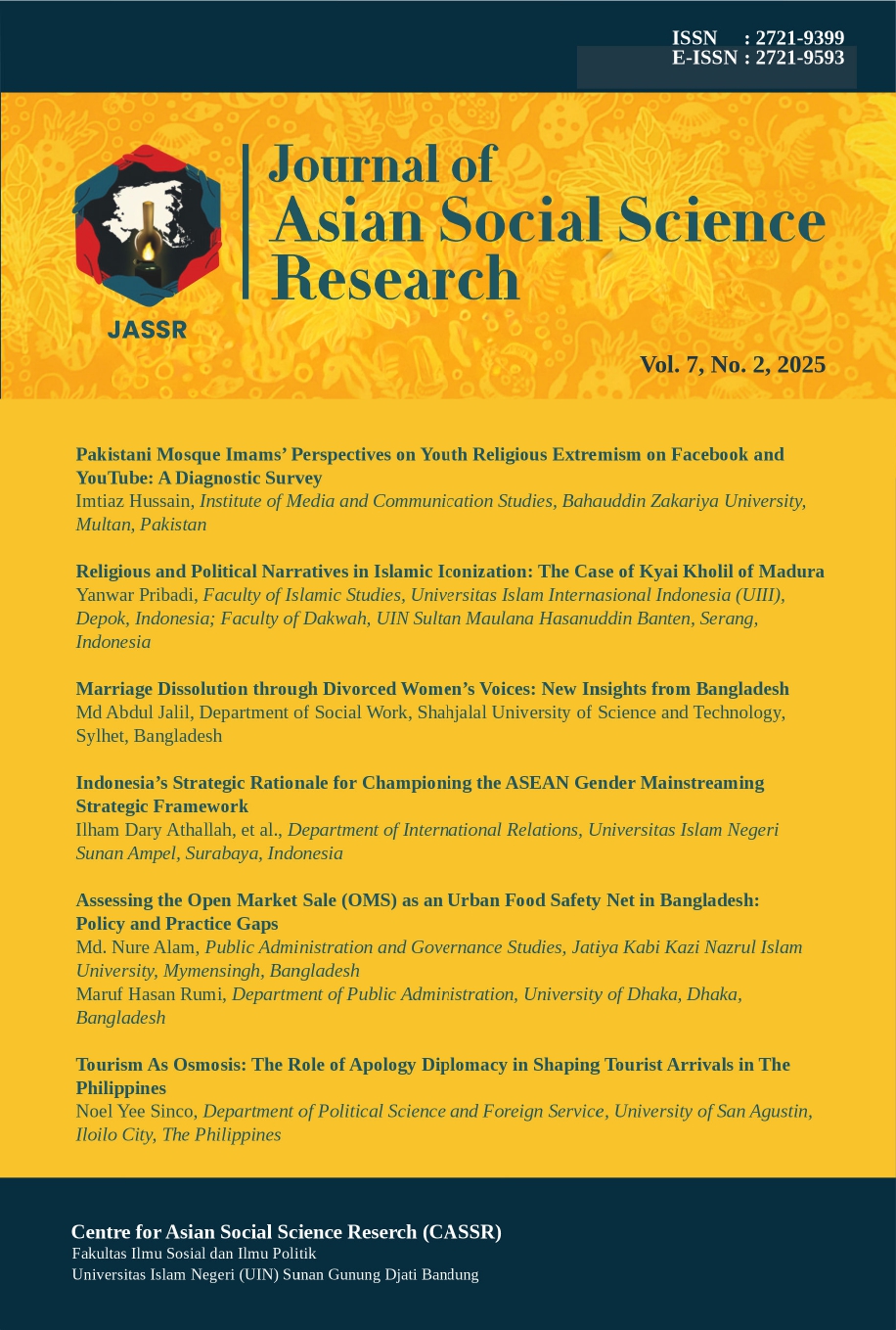
This issue of JASSR Vol. 7, No. 2 (2025) is about how authority, legitimacy, and vulnerability are negotiated in contemporary Asian societies. It examines the everyday sites where people decide who should be trusted, whose voice counts, how institutions gain or lose credibility, and how communities respond to uncertainty, inequality, and moral conflict. The articles approach these questions through diverse cases: mosque imams and online extremism in Pakistan, Islamic iconization and political memory in Madura, divorced women’s experiences in Bangladesh, Indonesia’s role in ASEAN gender mainstreaming, food safety-net delivery in Bangladesh, and apology diplomacy in Philippine tourism. Taken together, the issue shows that contemporary Asia is shaped not only by states, markets, and formal institutions, but also by lived struggles over trust, care, recognition, religious authority, gender justice, welfare, and public accountability.
| People |
| Editorial Team |
| Contact |
| Submissions |
| Author Guidelines |
| Reviewer Guidelines |
| Journal Template |
| Copyright Notice |
| Privacy Statement |
| Information |
| For Readers |
| For Authors |
| For Librarians |
Journal Indexing


.jpg)